Threshold: what happens to the mind in the sauna
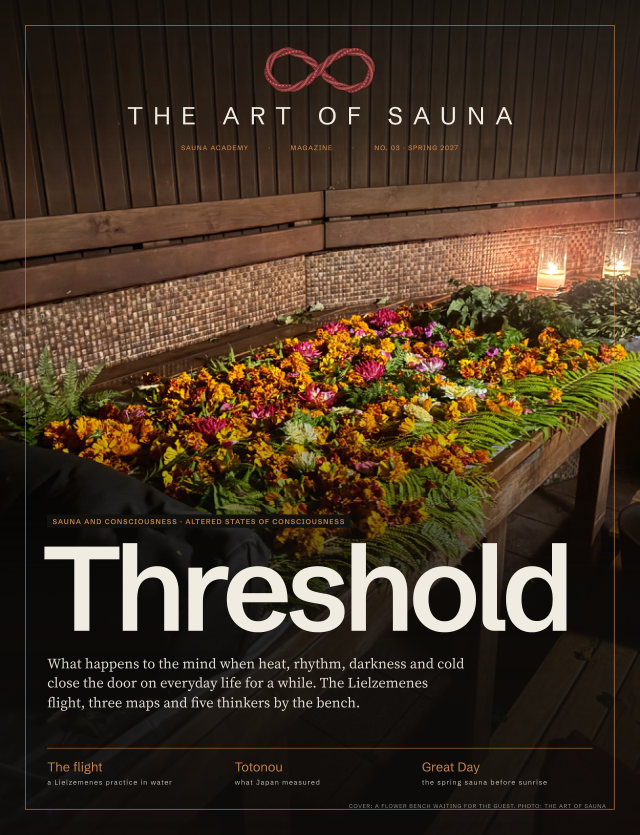
Altered states of consciousness, brain waves in the heat, time that stretches and disappears, and the flight. What Sauna Academy No. 03, the spring issue, is about.
There is a moment many sauna masters know. After the great whisking and the cold water, a person lies on the bench, and the world becomes quiet, wide and strangely close.
Juris Batņa, a doctor and psychotherapist, calls it an altered state of consciousness. In the third issue of Sauna Academy we call it the threshold: a place where you can step in either direction. That is why this issue is also about limits. In spring the year itself stands on a threshold: on the Great Day, day and night are equally long, and after that the light begins to win.
One of the oldest paths
In 1966 the psychiatrist Arnold Ludwig wrote that altered states can be brought about by sensory overload, by sensory deprivation, by rhythm and by physiological change. In the sauna almost all of these paths meet: heat, darkness, rhythm, scent, touch, the shock of cold and then silence. And the sauna does it gradually, with the possibility of stopping at any moment. The heat can be lowered; the door can be opened.
Heat in the brain
In 2020, Australian researchers passively warmed eight men to a body temperature of 38.4 °C. The EEG showed that beta power fell, while alpha power in the frontal lobes rose relative to the rest. That fits what sauna masters describe as “the mind settling”. It was not a study of the sauna ritual, and the EEG of a full Latvian ritual has not yet been measured.
Time changes too. In the heat the inner clock speeds up and a minute feels long. During the whisking and the silence, attention is so full that hours merge into a single moment in memory. That is why there is no clock in the sauna: the sauna master keeps time with an inner rhythm.
The flight
At Lielzemenes this state is called the flight. After the great whisking, the sauna master leads the person into the water and holds them in their arms. The body falls asleep while awareness stays awake. After the contrast, the flight continues on the bench: lightness, spaciousness and a sense of being outside the body. It is a guided, deliberately sought deep practice that the person chooses with consent. In Japan the same moment has a word of its own: totonou, “to come into order”. And there it is already being measured.
We do not measure a sauna by how deep someone went. We measure it by how well they came back.
Three maps, one threshold
At the heart of the issue are three maps: Juris Batņa’s five steps, Adam Apollo’s matrix and Holodynamics. Three completely different systems, and all of them describe one structure that the anthropologist Arnold van Gennep found in rites of passage all over the world in 1909: separation, threshold, return. And all three say the same thing: the culmination is not the end. Integration is the end.
LD 1096Pirtiņā ieiedama,
Zelta sviedu gredzeniņu:
Ņem, Laimiņ, zelta ziedu,
Neņem manu dvēselīti.Stepping into the little sauna, I threw a golden ring: take, Laima, the golden flower, do not take my little soul.
In the dainas the sauna is Laima’s room, where a woman gives birth and where life and death stand in one space. It is a threshold in the most direct sense. The feeling that a slightly different person comes out of the sauna than went in has stayed the same through the centuries.
Sources: Ludwig A. M. (1966) Arch Gen Psychiatry 15:225; Vaitl D. et al. (2005) Psychol Bull 131:98; van den Heuvel A. M. J. et al. (2020) Eur J Appl Physiol 120:2797; Wearden J. H., Penton-Voak I. S. (1995) Q J Exp Psychol B 48:129; A. van Gennep (1909) Les rites de passage.
This issue is in the course. Sign up with your email and read all of it on your phone, in your language.
Read in the course →