Balance: what heat really does to the body
Thirty minutes at 73 °C, twenty years of Finnish research and a doctor who calls the sauna an encounter. What Sauna Academy No. 02, the winter issue, is about.

The sauna is a controlled load, and its value lies in the cycle: heat, rest, recovery.
In the dainas, Māra whisks a girl “wishing her health”, and a Latvian proverb says: the sauna is the health of the household. Today’s science reaches a similar conclusion from a completely different side, with a blood pressure cuff and thousands of people followed for decades. Science, though, is more careful than the song. It says: associated with, not caused by.
Thirty minutes at 73 °C
In 2018, Finnish researchers measured 102 adults before and right after 30 minutes in a sauna at 73 °C. Heart rate rose on average from 65 to 81 beats per minute. Systolic blood pressure fell for a while from 137 to 130 mmHg, and the arteries briefly became more elastic. It was a single session without a control group, so it proves nothing yet about long-term effects.
The measurements confirm something simple: in the heat, the body works. The blood vessels of the skin widen, the heart pumps more blood to the surface, and sweat cools. That is why a more intense sauna is not automatically a healthier one. The dose of heat is made of temperature, humidity, time, the height of the bench and the person’s state today.
2,315 men, twenty years
In eastern Finland, the Kuopio study followed 2,315 men for almost twenty years. Those who went to the sauna 4–7 times a week had a 63 % lower risk of sudden cardiac death than those who went once a week.
These are strong numbers, and that is exactly why they must be read carefully. This is an observational study: it shows that frequent sauna and lower risk go together, but it does not prove that the sauna causes it. The comparison is with people who go once a week, not with people who never go. And a Finnish sauna is not the same as a full Latvian sauna ritual with whisks and contrast.
Association is not causation. That is the most important rule when reading research about the sauna.
In brief
Sweat cools the body, and metabolic waste is removed by the liver and kidneys. The weight that goes in the sauna is water, and it comes back when you drink. The sauna works best together with movement, and alcohol does not belong in it: it is one of the main risk factors in the heat. The most valuable sauna is the one whose load suits this particular person.
The change after the heat
The biggest change in the sauna happens not in the heat but after it. It is guided by the vagus nerve, which runs from the brainstem to the heart, the lungs and the digestive organs. In the heat the sympathetic system takes over: the heart beats faster and the sweat comes. When you step outside and cool down, the vagus nerve returns: the heart slows, the breath deepens and heart rate variability rises. That is why rest is not a pause between the “real work”. It is the other half of the sauna.
The capacity to love and to work
Juris Batņa, a doctor and psychotherapist, calls health the capacity to love and to work, in exactly that order. In his view, the sauna is not a procedure but an encounter: with your own body, with another person and with your own culture. His five steps are like five fingers: each one is different, but the hand only works when they are joined into one whole.
LD 1280Ko tur pēra, ko tur pēra
Mīļas Māŗas pirtiņā?
Ilzi pēra mīļa Māŗa,
Veselības gribēdama.Who was whisked, who was whisked in dear Māra’s little sauna? Dear Māra whisked Ilze, wishing her health.
Sources: Laukkanen T. et al. (2015) JAMA Intern Med 175:542; Laukkanen T. et al. (2018) J Hum Hypertens 32:129; Lee E. et al. (2022) Am J Physiol Regul Integr Comp Physiol 323:R289; Hannuksela M. L., Ellahham S. (2001) Am J Med 110:118.
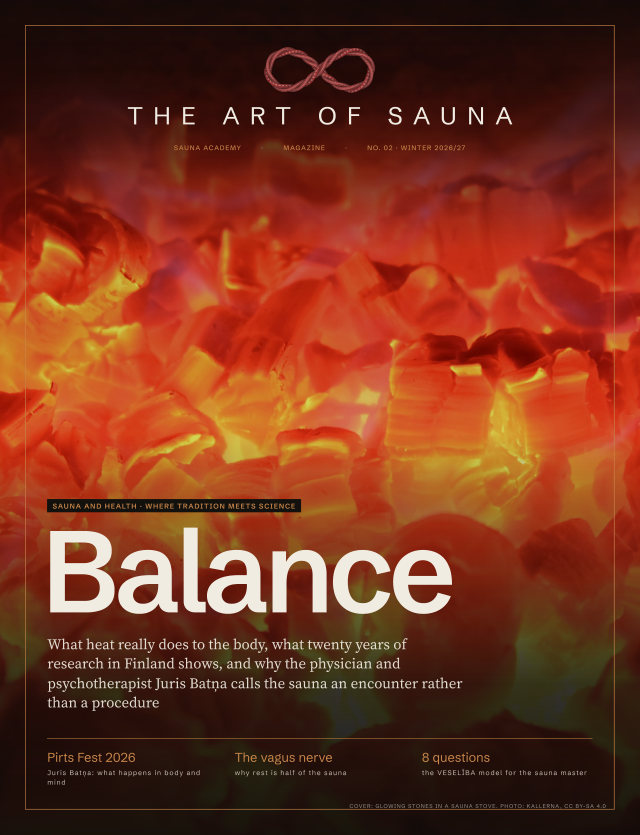
This issue is in the course. Sign up with your email and read all of it on your phone, in your language.
Read in the course →