Ritual Whisking — Five Steps in One Flow
Whisking is a journey from the first touch of wind to silence and gratitude.
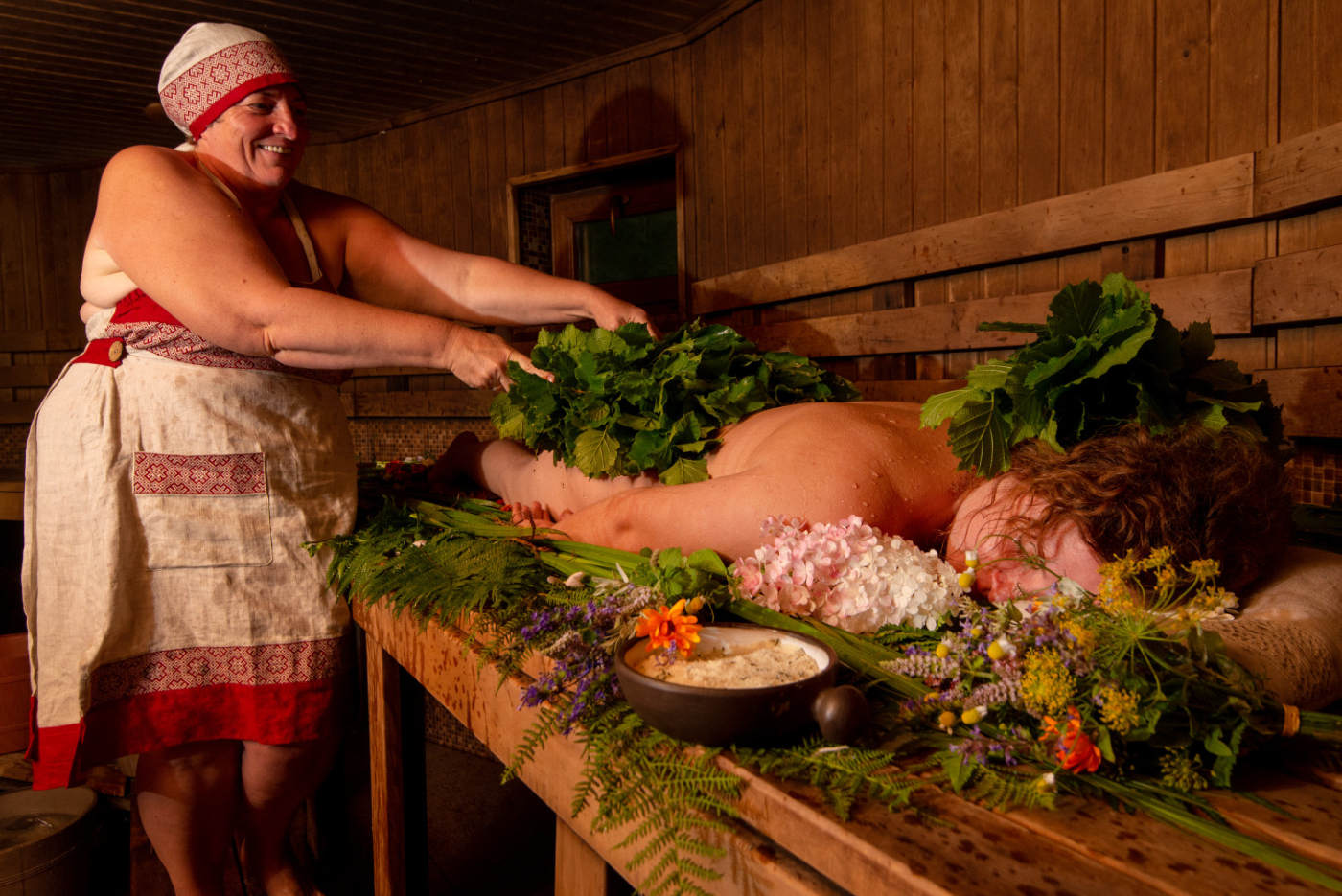
Imagine a sauna master holding two whisks.
They have not touched the body yet. The first movements happen in the air. The whisks lift heat from the bench, gather the steam and bring it down. Leaves rustle. The air begins to move. The person feels the whisking before the first touch.
Then the whisks come closer. Heat gathers above the back like a blanket. The first light contact follows, and gradually the rhythm becomes fuller. One movement opens the next. One whisk lifts the steam; the other places it on the body. Sometimes they work as a pair, sometimes each has a separate task.
From the outside, it may look like striking someone with branches. From within, it is a precisely shaped sequence.
Ritual whisking is a five-step journey: warming, cleansing, stimulation, protection, contrast and transformation.
The whisk as an instrument
In the hands of a sauna master, a whisk is several tools at once. It is a fan that moves hot, humid air. It is a brush that paints warmth onto the body. It is a compress that holds heat in one place. It gives rhythm and touch. And it is part of a landscape — a tree, a season and a place entering the sauna through the scent of its leaves.
A broad oak or maple leaf gathers a large volume of air and creates a deep wave of warmth. Fine birch twigs are lively and flexible. Linden offers a soft touch. Juniper speaks in concentrated points. In the ritual language, rowan closes the work and draws its boundary.
Each step of the whisking has its own whisk. They are arranged like words in a sentence — each with its place and time.
Why whisking needs a sequence
A beautiful song is not played by striking all its notes at once, and whisking builds the same way. The body first needs to feel the room, the air and the first movement of warmth. Touch arrives gradually. The rhythm grows, reaches its centre and then settles.
Sequence is what makes ritual whisking a whole rather than a demonstration of separate techniques. In The Art of Sauna practice, ritual whisking consists of five steps: warming, cleansing, stimulation, protection, contrast and transformation.
The five steps of ritual whisking
- Warming: from wind to compressWhisking begins with warmth. The sauna master moves the air with the whisks, raises the steam from the bench and guides it towards the body. At first, the leaves may not touch the skin — they work as fans, gathering hot, humid air and lowering it over the back. An air cushion forms: heat remains above the body for a moment before the whisks come down and become warm compresses. Broad oak and maple whisks gather heat in a full wave; birch gives a flexible movement, linden adds softness. Heat is built layer by layer, until the back is ready for everything that follows.
- Cleansing: making roomOnce the body is warm, cleansing begins. In the Lielzemenes tradition, this step may use aspen, juniper, mugwort, wormwood and other bitter plants. Aspen creates a light movement with its fine, trembling leaf; juniper brings a sharp scent and concentrated touch; mugwort carries the aroma of the meadow and an ancient ritual character. The whisks follow the contours of the body — the back, shoulders, sides and legs. The movement leads away, as though removing what no longer needs to be carried.
- Stimulation: the body becomes a map of rhythmGentle stroking grows into rhythmic contact. The movement may be long and flowing or short and precise. The whisks work in pairs: one maintains the warmth while the other touches; one marks the direction and the other continues it. The body is read as a whole — back, shoulders, arms, sides, legs and feet meet within one rhythm. Particular attention is given to the feet, the place with which the person will stand on the earth again. What decides is the ability to create a complete sensation of warmth and touch through a small movement. When the rhythm holds, attention stops rushing ahead and remains within the body. Special-purpose whisks enter here: willow speaks of flexibility, maple of balance, linden of gentleness, oak of strength. In Lielzemenes practice, bird cherry has become an image of forgiveness; lilac belongs to love and spring awakening; apple recalls maternal love and home.
- Protection: closing the boundaryAfter stimulation, the rhythm changes. The movements become more collected as the sauna master completes the work on the back of the body. In the Lielzemenes ritual language, rowan whisks are used for this fourth step — in Latvian symbolism, rowan is a tree of protection and boundary. The whisks trace the body's outline and consolidate the work of the first three stages. It places a boundary on one part of the whisking before the body is led into contrast. When the back has been whisked, cooling follows: cool whisks are placed on the body and cool water is poured over them. The person then turns onto their back, and the front of the body follows the same five-step sequence.
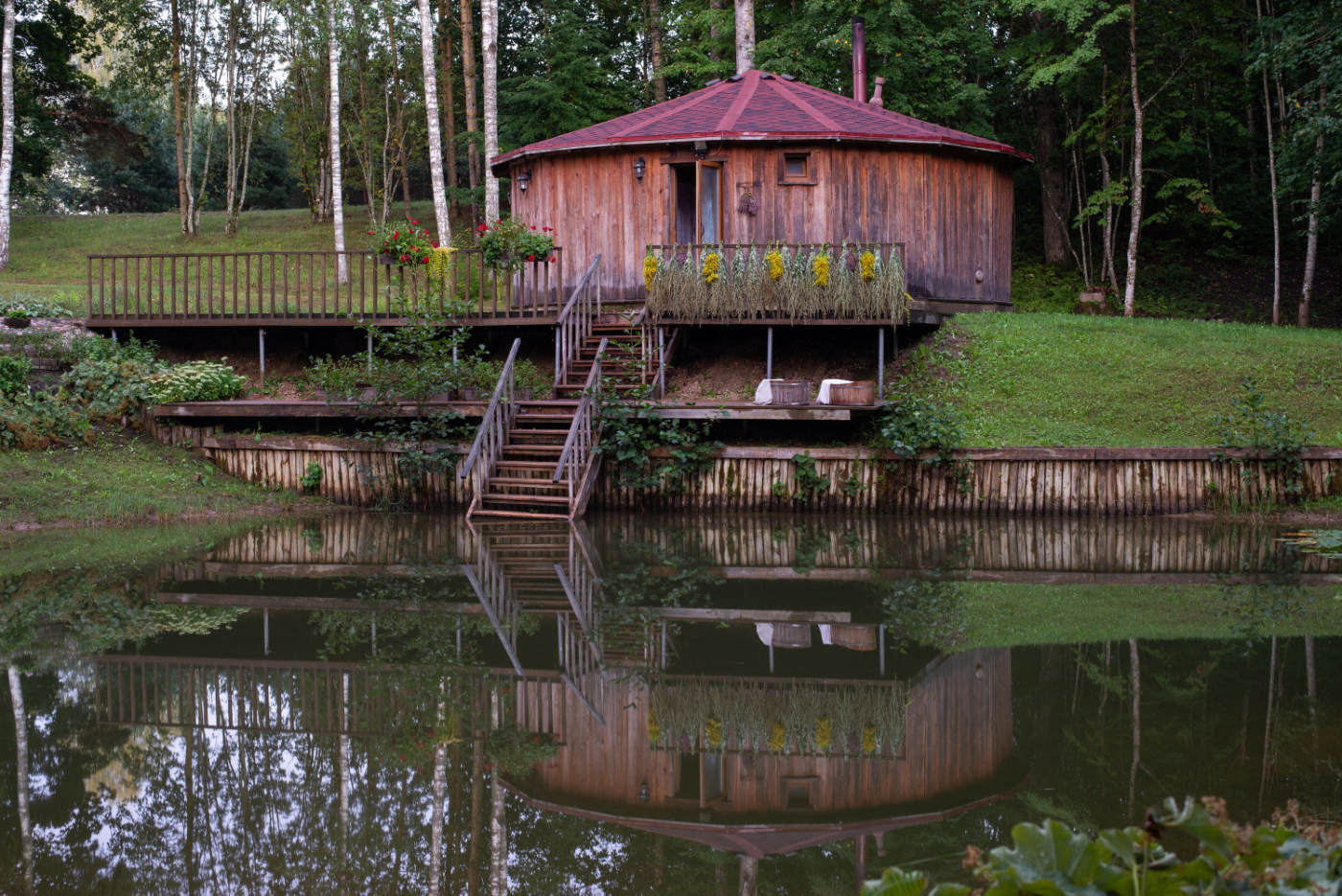
- Contrast and transformation: from bench to waterThe fifth step begins on the bench with cooling, but reaches its fullness in water. Once the front of the body has also been whisked, the sauna master accompanies the person to a pool, pond or lake. The sauna master holds the person in their arms and allows the body to enter a weightless state. Water takes over the weight; the muscles no longer need to hold anything, and after warmth, rhythm and touch the body can release completely. Contrast here fulfils the whisking: a passage from heat to coolness, from weight to weightlessness, from the active work of the sauna master to the holding power of water. The body releases, renews and returns to its starting state. Only after this water stage is the ritual whisking complete. Silence and gratitude follow.

Nine plus three: the dramaturgy of whisks
The book Tauta, kas aicina pirtī Dievu — The People Who Invite God into the Sauna — describes the "small three-times-nine": nine plus three whisks arranged for one ritual.
| Place in the sequence | Number | Task |
|---|---|---|
| Warming whisks | 2 | Guide steam and build warmth in layers |
| Cleansing whisks | 2 | Make room for the next stage |
| Stimulation and special-purpose whisks | 2 | Build rhythm and carry the intention |
| Protection whisks | 2 | Close the stage and strengthen its boundary |
| Pillow and cooling whisks | 1 + 3 | Support the head and open the contrast stage |
Twelve is not a rule for every session. The number reveals a structure: the instruments are divided into roles, and each role appears in its own moment — like dramaturgy.
Each whisk has its own voice
- BirchFlexible, lively and versatile. It can fan, stroke, create rhythm and make full contact. It is often the first whisk through which a sauna master learns to listen to the air.
- OakBroad and steady. It gathers steam well and creates deep, full warmth. In Latvian cultural language, oak carries the image of strength and a firm stance.
- LindenA soft touch and, in bloom, a distinct summer scent. Associated with gentleness, the feminine and maternal presence.
- MapleA fresh maple leaf is broad and soft. It covers the body, holds warmth and creates calm, full contact. In Lielzemenes practice, maple carries the theme of balance.
- JuniperNot a broad warming whisk. It works through scent, the pattern of its needles and concentrated contact. It belongs to the cleansing stage.
- RowanEnters at the end. Its cultural image is protection and boundary. It places the full stop on the whisking.
The sauna garden continues on the bench
The plants of ritual whisking do not begin with a ready-made whisk. They begin in the sauna garden, meadow and forest. The sauna garden is a living store of materials: herb bundles, fillings for mixed whisks, plant compresses, herbal pindas and material for the bench bed. Woody branches give a whisk its structure, working surface and rhythm. Meadow plants add another quality — softer, more fragrant and closer to the earth.
Herb bundles and cocktail whisks
Tansy forms a firm, aromatic herb bundle; in the Lielzemenes language it belongs to the cleansing stage alongside mugwort, wormwood, aspen and juniper. Birch can be combined with mugwort, wormwood, tansy or hemp — birch gives structure and flexibility, the herbs add scent, rustle and ritual character.
A cocktail whisk combines several plants in one instrument: a flexible birch base may hold mugwort, tansy, hemp, mint, meadowsweet, fern or other seasonal plants. Its purpose is to bring together only the plants that each add a note to the whole. One mixture may serve cleansing, another stimulation and another a quiet closing.
Compresses: when the whisk becomes still
Sometimes the deepest warmth arises when the whisk stops. The sauna master gathers steam, lowers the warmed whisks onto the body and holds them there. The whisk becomes a compress — heat no longer travels across the skin but remains on the feet, legs, back, shoulders or neck.
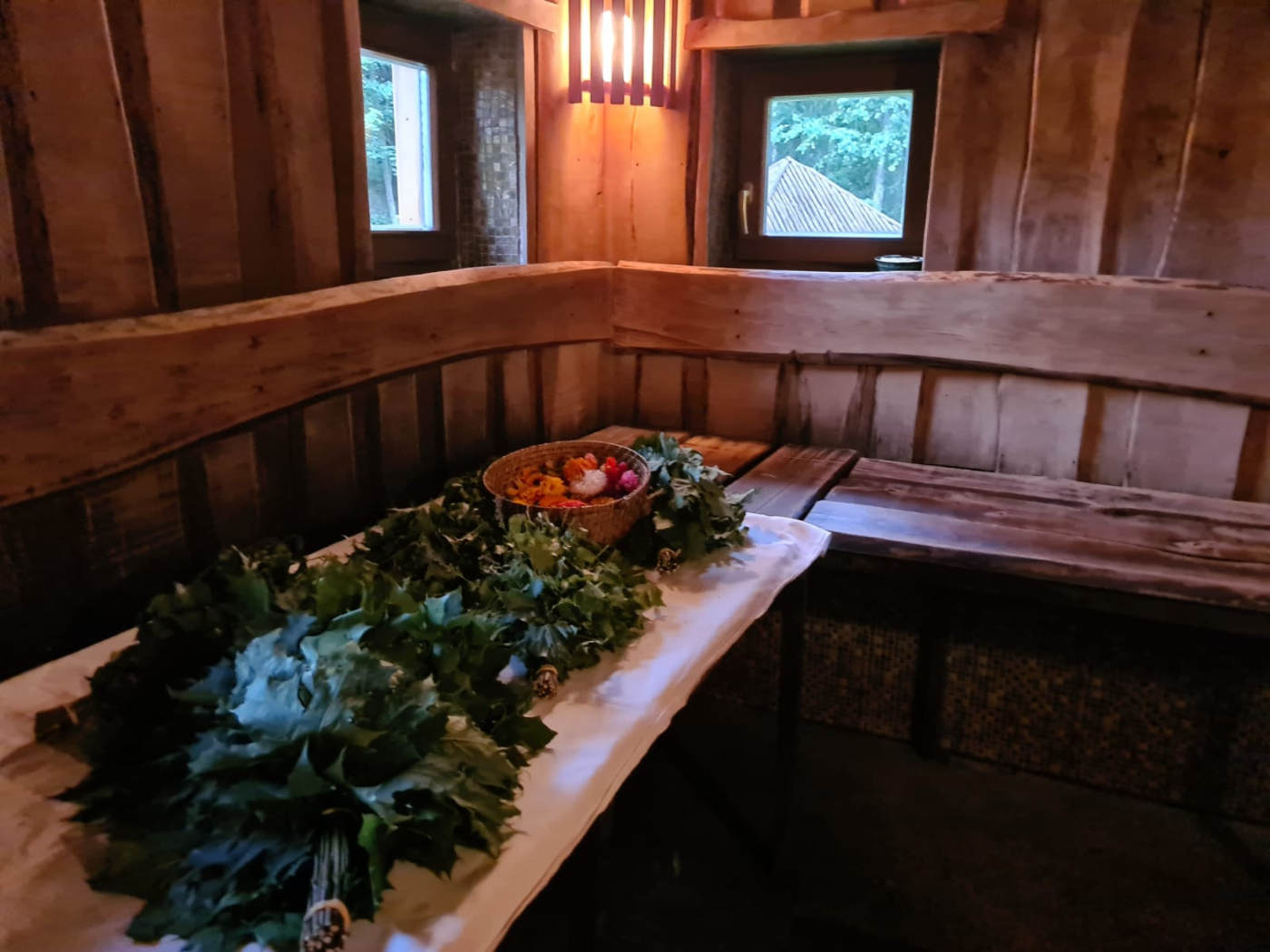
Compresses alternate with fanning, rhythmic contact, long strokes and contrast pouring. After a quick rhythm, a compress is like a sustained note that lets the body hear the previous movement. Garden plants may also be used in cloth-wrapped pindas or spread on the bench as a plant bed of hay, fern, clover, meadowsweet, chamomile, mint and flowers.

The infinity movement
The movement of ritual whisking rests on a flow that returns into itself. In The Art of Sauna technique, this flow takes the form of the infinity sign — a horizontal figure eight.
The sauna master draws the figure eight with the whisks over the back, lower back, legs and the whole body. One hand begins an arc and the other receives it. The movement crosses the centre, opens to one side, returns and continues on the other — with no sharp beginning and no broken end. The legs are not treated as two separate lines; the infinity movement joins them into one rhythm.
The movement joins the right and left sides, keeps the rhythm fluid, lets one hand pass the movement to the other and returns every arc to the centre. The source Tauta, kas aicina pirtī Dievu also places a figure eight above the person at the end of the whisking; in The Art of Sauna practice, it has become the foundation of the entire movement. This is why infinity is also the symbol of The Art of Sauna — a movement that does not break: heat passes into coolness, touch into silence, one side of the body into the other, and the end of a ritual into the beginning of a new state.
Word and song in ritual whisking
The whisks have their own sound, and alongside them the human voice. At the Lielzemenes Sauna School the whisking is accompanied by words and prayers written down in the book „Tauta, kas aicina pirtī Dievu” (2014). A word can open a step, set the rhythm of a movement, name an intention or close the whisking. It joins the breath, the rustle of leaves and the repetition. The words below are given in the original Latvian, with a plain translation and a note on what they carry.
Opening the whisking Nāc, Dieviņ, pats palīdzi
Grūta darba padarīt;
Tev bij spēks, tev varīte,
Tev gudrais padomiņš. Come, dear God, and help
to do this heavy work;
yours was the strength, yours the might,
yours the wise counsel. A work-song opening. Before hard, careful work, the singer asks Dievs — the old Latvian sky-god, keeper of order and fate — to join the task. Not to do it for them, but to lend steadiness, strength and good judgment. The whisking begins as shared work between the master, the guest, and something larger.
In the cleansing step Visas vainas, visas kaites —
No lāviņas palāvē.
Velc baltu mugurā,
Met melnu ugunī. All faults, all ailments —
from the bench to the space beneath it.
Pull white onto your back,
throw the black into the fire. A cleansing charm. Whatever is sick or heavy is swept off the body and downward — off the bench, under it, out of the room. Then the person “puts on white” (clean linen, a clean state) and “throws the black into the fire,” where it burns. The old logic of the pirts: trouble is physically carried away and destroyed.
Working with the feet Lai pēdiņa viegla, viegla
Māras zemi staigājot,
Lai Dieviņš ceļu rāda
Tumšajā naksniņā. May the foot be light, light
walking on Māra’s earth,
may dear God show the way
through the dark night. Māra is the earth-mother — she keeps the material world, the body, everything that is made. To walk lightly on Māra’s earth is to move through life, and through this hard passage, without harming it or being weighed down. The second half asks for guidance through the dark: the disorientation of deep heat, or of a hard stretch of a life.
During stimulation Dod, Dieviņi, kalnā kāpt,
Ne no kalna lejiņā;
Dod, Dieviņi, otram dot,
Ne no otra mīļi lūgt. Grant, dear God, to climb the hill,
not to go down from the hill;
grant, dear God, to give to another,
not to beg kindly from another. A prayer for the strength to be the one who rises, and the one who gives — rather than the one who slips downhill, or the one who must ask. In the whisking it marks the turn toward vitality; as life-wisdom it is about keeping your dignity through your own effort and an open hand.
In the protection step Tais, Dieviņi, dzelžu sētu
Apkārt puiša (meitas) augumiņu,
Tais, Dieviņi, tēraud’ sētu
Apkārt puiša (meitas) augumiņu,
Tais, Dieviņi, zelta sētu
Apkārt puiša (meitas) augumiņu. Build, dear God, a fence of iron
around the lad’s (the girl’s) body,
build, dear God, a fence of steel
around the lad’s (the girl’s) body,
build, dear God, a fence of gold
around the lad’s (the girl’s) body. A protective charm — a triple fence of iron, steel and gold drawn around the body. Iron and steel keep harm out; gold marks the person inside as precious, worth guarding. Sung near the end of the whisking, it seals the work and sends the person back into the world protected.
In closing Paldies Dieviņam,
Paldies Māriņai,
Paldies pirtiņai,
Paldies pirts gariņam. Thank you, dear God,
thank you, dear Māra,
thank you, dear little sauna,
thank you, dear spirit of the sauna. The closing thanks — to Dievs, to Māra, to the sauna itself, and to its spirit, the pirts gariņš, the household guardian who lives in the bathhouse. Nothing is asked. The ritual ends in gratitude, and then in silence.
Gratitude is the last movement made with words. Silence remains after it.
The sauna master conducts heat
The central skill is the ability to feel, at the same time, the movement of steam, the weight of a whisk, the surface of its leaves, the person's breath, the warmth of the body and the exact moment of rhythm. The sauna master is like a conductor, joining fire, water and plant in time. Heat raised too early becomes sharp; a movement changed too late loses its rhythm. When everything finds its place, two whisks begin to sound like one instrument.
Whisking begins before touch and ends after it
Ritual whisking begins when the sauna master chooses and arranges the whisks — knowing which will warm, cleanse, stimulate, protect and bring coolness. It continues in the air before the leaves first meet the skin. It reaches its centre in rhythm, warmth and work with the whole body. And it does not end with the last movement on the bench — it ends in water, when the body enters weightlessness in the sauna master's arms, releases completely and returns to itself.
Warming. Cleansing. Stimulation. Protection. Transformation.
Five steps. One whisking.

The first three issues of Sauna Academy on your phone, in your language. The full texts, dainas and practice for your sauna.
Start the course